
Our next teardown is the INMO Go AR Glasses, one of the first glasses to truly tackle an AR design without severely light-lossy optical elements used to project an image like the display glasses from Rokid, Xreal, and many others. This is the first time we are seeing a microLED display in one of these glasses, coupled with a diffractive waveguide from an unknown vendor. (see diagram below).
The monochrome green display panel used in these glasses is more than bright enough to deliver high-contrast information to the user even in a very brightly lit room. Outside the 2000nit rated glasses may start to suffer from poorer readability, but the included magnetic attachment (nice!) gives a nicer black background and significantly reduced light transmission (almost 90% of light transmission blocked). The diffractive waveguide used to project the image to the user’s eye is a novel optical element we’ve not seen in other glasses so far, but unfortunately it did not survive this teardown…
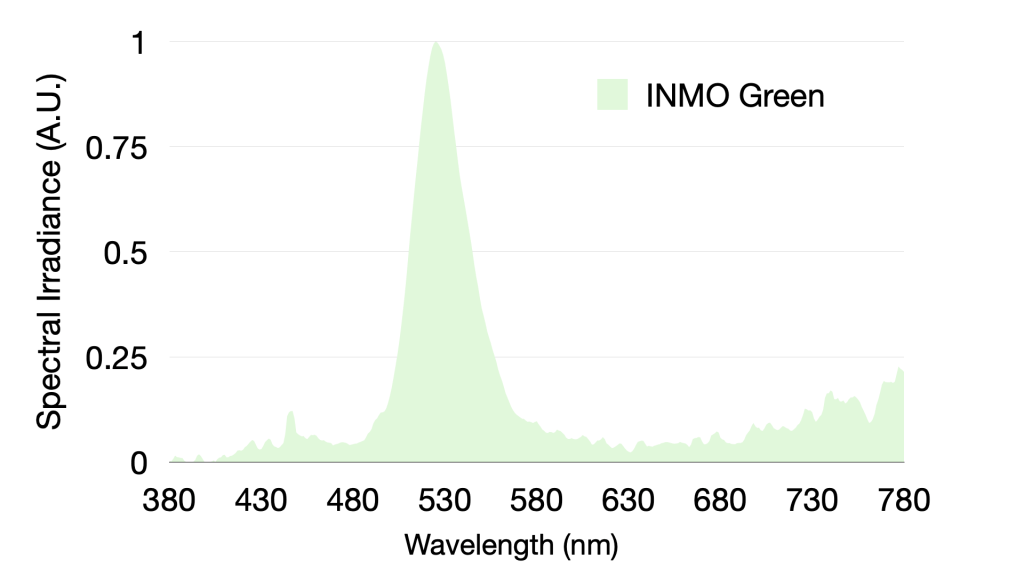
Display-wise, INMO uses a JBD Hummingbird Mini I picoprojector module, a highly power efficient (<60mW at 100% APL) and incredibly bright (up to 5M nits!) panel. You can see the spectrum collected from the diffractive element in green below.
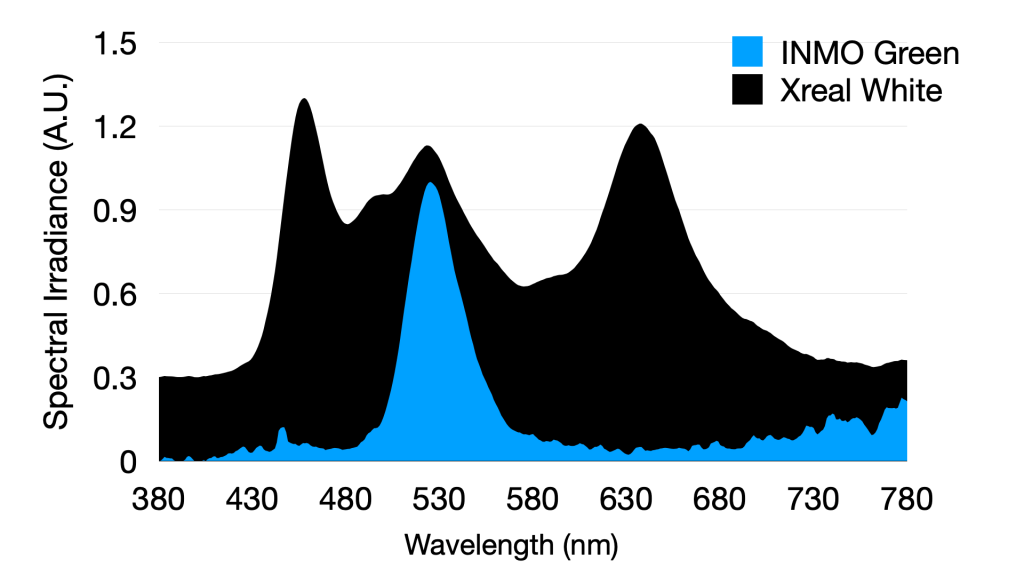
When we compare INMO’s output spectrum to the white spectra of display glasses like Xreals, we can see the lack of characteristic emission in the 450nm and 640nm blue and red regions. The actual FWHM of INMO’s green emission is ~34nm, more inline with the excellent green emission from RayNeo’s SeeYA OLED panel.
From an optics perspective, this is where we first diverge from the typical birdbath design seen in all of the display glasses so far. While we still start with a flat panel display as usual marked in (1), this architecture now uses a microLED display instead of all of the OLED panels we’ve seen so far. This actually has countless differences that we could explore, but the key difference for this audience is that we no longer have organic materials in the emission stack, but an all-inorganic architecture – allowing for more efficient light output, higher driving currents, and ultimately much higher brightness.
Another major difference is the lack of passive polarization control through the optics. Since we have unpolarized light emitted from the display in (1), we continue to output similar unpolarized light through the lens elements that magnify our image in (2) and then the input (3) and output (4) gratings.
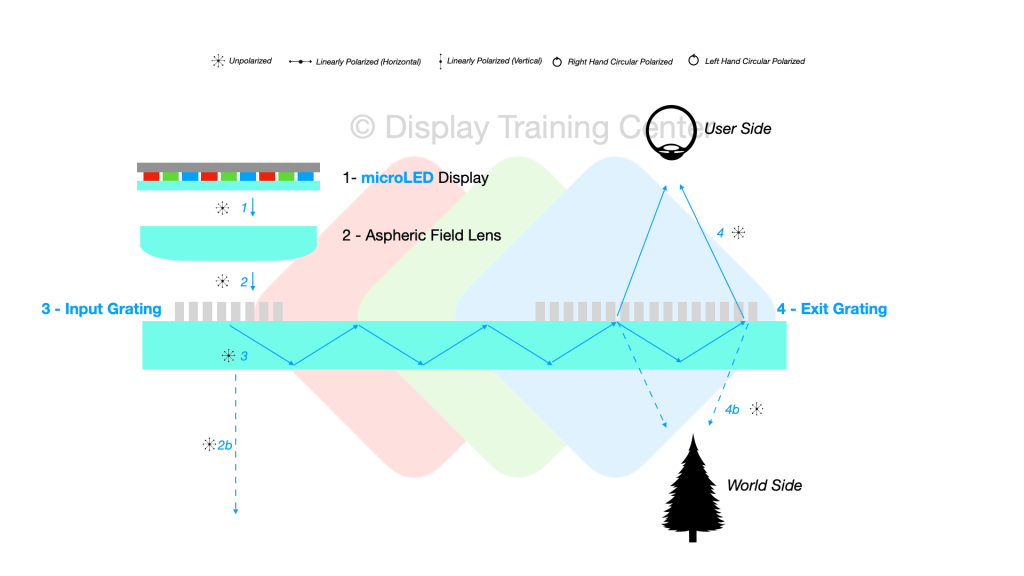
To astute readers of the blog, this reduced polarization flipping scheme would maybe seem like this architecture would be very efficient in delivering all of the up to 5M nits that JBD rates this panel for, directly to the eye… unfortunately this is not the case. Waveguides, particularly diffractive ones like the type found in the INMO glasses, are exceedingly lossy. You will notice undesired rays (2b, 4b) in the schematic above that are not to scale in terms of magnitude of light loss – in fact, more than 60% of all emitted light is actually lost in this ray path based on empirical testing. We also have further losses throughout the entire glass body that are not shown here since we never have truly perfect total internal reflection as ray (3) may suggest. Finally, the diffractive element extracting light to the user’s eye doesn’t just do so in this direction, but also away to the world side – the major reason you can also see the projected image if you are looking at someone wearing these glasses.
That wraps up the optics teardown and analysis for the INMO Go’s – next time, we’ll take a look at all of the other components in the device.

 Display Training Center
Leave a comment