
ENGO Eyewear has been on my list for a while now and one Gen1 eBay order later, as well as a Gen2 provision by my friend Chen at Saphlux, meant that it was time to tear-down these glasses and see the internal monochrome yellow microOLED panels at work.
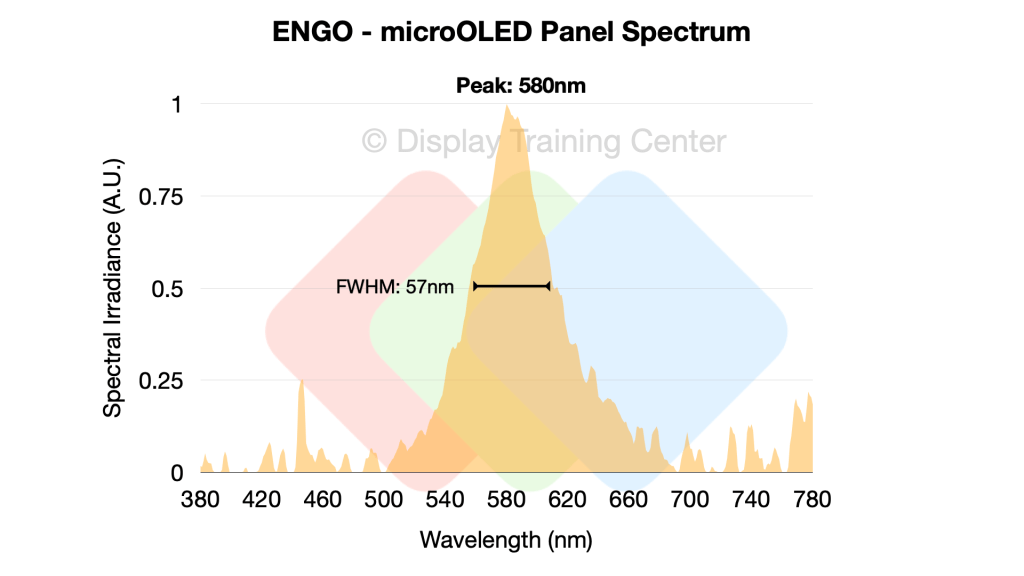
The display panel is a new component we haven’t seen before, manufactured by French company MicroOLED Technologies. Their 0.19″ monochrome yellow display is an incredibly power efficient panel rated at only 3mW of power draw… the entire system draws more than this, but still low enough for an all-day wear. This new-to-us yellow emitter material peak is centered at 580nm with a respectable 57nm FWHM.
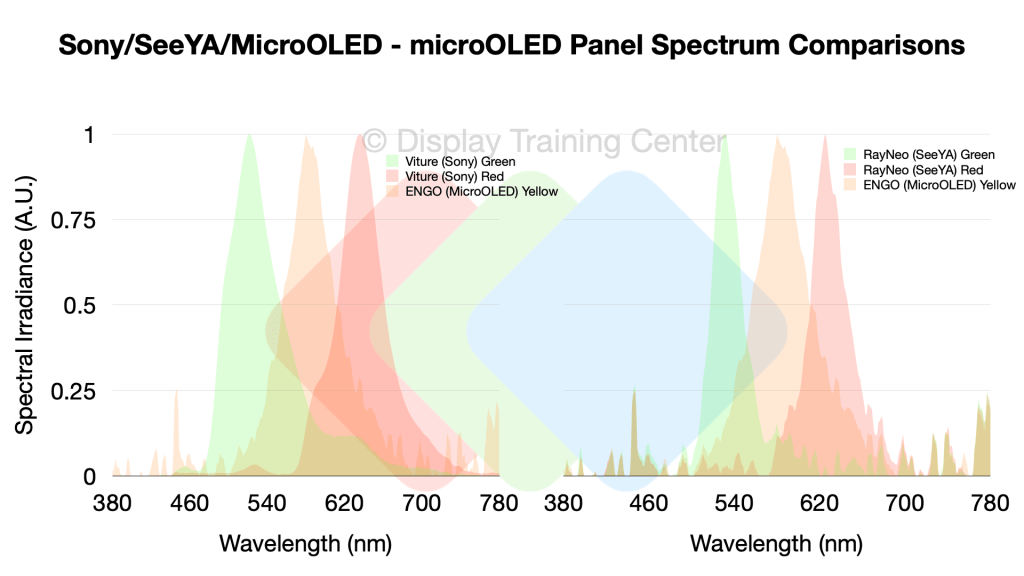
I found it pretty interesting to see a yellow emitter in these panels – most monochrome displays choose to use one of the 3 primaries that you would see in any other consumer display (blue, green or red – primarily green though…). MicroOLED does have monochrome red panel options, but this color as a consumer is likely less acceptable due to potential overlap with road signs that are red themselves, a perception of red text warning of danger, and a host of other user experience reasons – technically, these panels are rated at similar brightnesses and power draws, though I suspect we would see a lower brightness for similar input power in red panels.
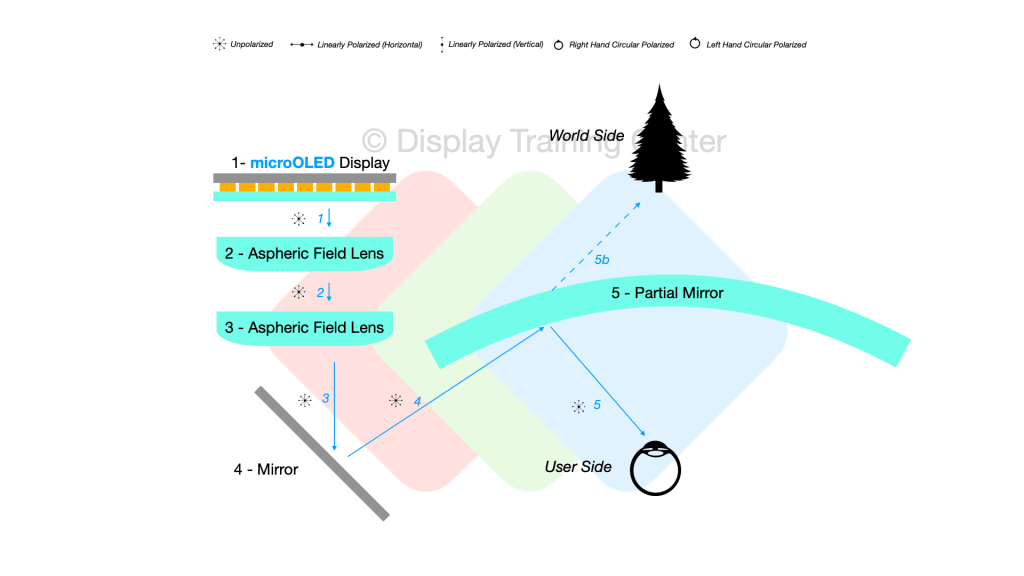
While there is more data on weight, force and battery consumption on Patreon, the optical path is a very simple but power efficient structure. Starting with the (1) microOLED display itself which emits unpolarized light, we pass the image into two separate aspheric lenses (2 and 3) which don’t really attenuate any light through the lenses themselves. Where we do have some light loss is at the air/lens interfaces which while they are anti-reflection coated, it’s likely we lose ~1% with each lens entry. The mirror (4) is a completely reflective surface, which continues the efficient light propagation path until the partial mirror (5) on the outward-facing lens. Here is where we start losing efficiency, in the form of ~50% light reflected to the eye and the rest (5b) lost to the world side. Given the very high brightness of the panel to begin with (up to 35k nits), this means that we have as much as 17k nits to the eye – plenty bright enough to see even on an incredibly sunny day. This is before the photochromic lens reduces world-light transmission to <20%, further increasing the contrast of the display.
That’s it for now – as always, all raw data collected and used here is available for all tiers of paid Patreon subscribers here: https://www.patreon.com/cw/DisplayTrainingCenter

 Display Training Center
Leave a comment