
I wasn’t planning to really tear apart a new pair of display glasses, and especially not the RayNeo ones since I already took a look at the RayNeo Air 3S last year. That said, RayNeo’s community folks had another plan (thanks Stella!) and sent me a free unit to b̶u̶t̶c̶h̶e̶r̶ review however I want… great! This, coupled with the fact that these had the updated & much brighter SeeYA 0.6″ microOLED panels, made me rethink my plan and go take another look at what is a very similar overall product design:
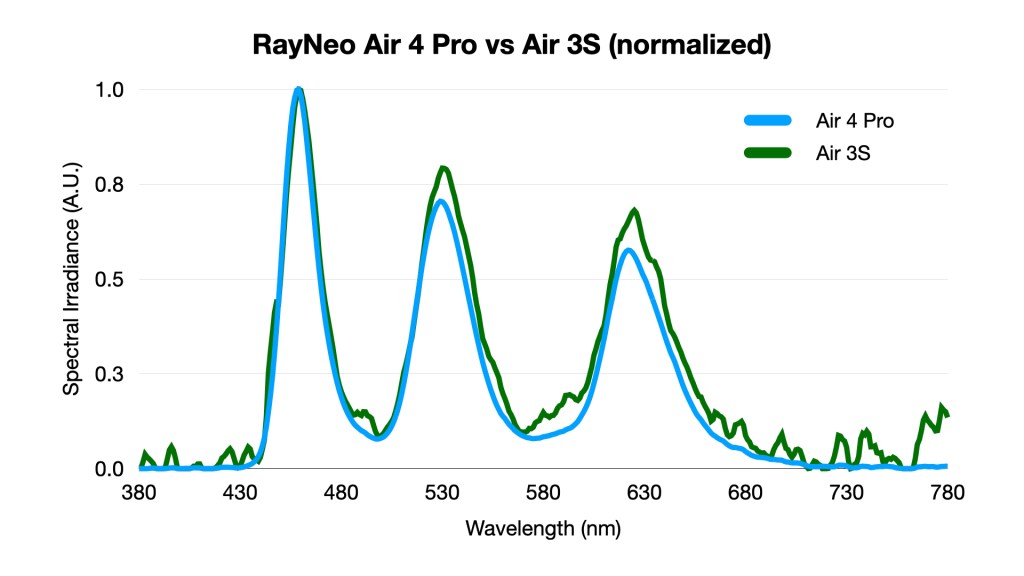
There’s plenty of data shared in the video and you can take a look there (or directly download some of that data over on Patreon), so here we will just look at some of the display measurements since that was the main draw for analysis in this teardown… The spectrum is pretty much the same as the one seen in the lower brightness SeeYA panels from last year, which is significantly better than Sony’s WOLED+CF version. Honestly at this point I’m not quite sure what the justification would be for other brands to go with any microOLED that doesn’t use direct RGB – Sony is very likely the most expensive vendor here, and provides a degraded image quality with similar if not higher power draw. Is the lifetime of the device really that much better in Sony vs. SeeYA (and the now emerging INT Tech)?
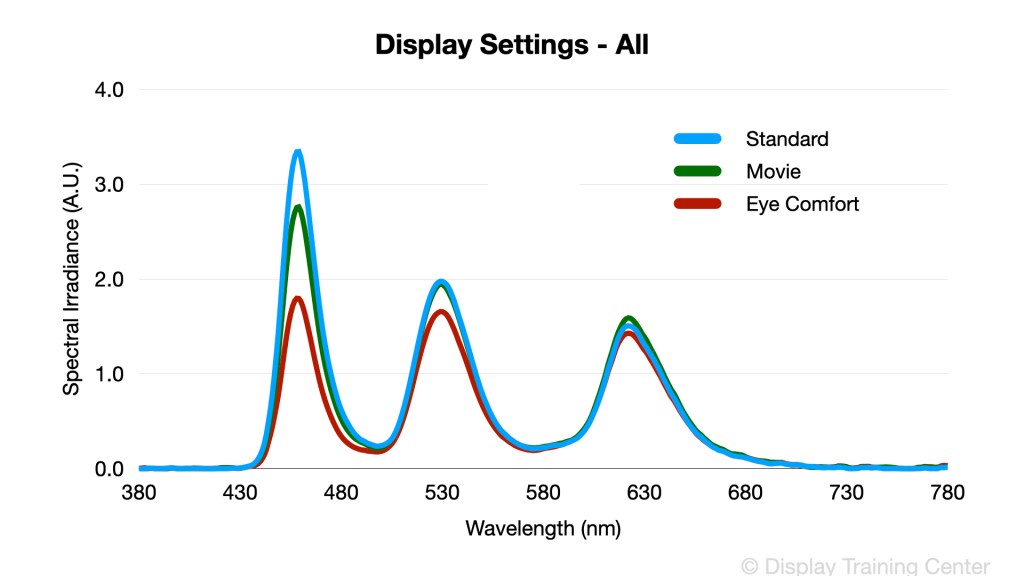
In a similar vein, you can see the pixel-level tuning to the image when you select between the different display settings (called ‘Picture Modes’ when tuning the image in the device) – primarily, this is a gradual decrease in the maximum brightness of the blue emitter relative to the green/red channels. In ‘eye comfort mode’ we do also see a slightly lower green intensity which makes all peaks roughly equal, but the bigger contribution to the overall red-shifting of the image (all tested on 100% APL white images below) is the blue intensity decrease.
Optics wise that’s pretty much it – the rest of the optical path is seemingly unchanged from the original RayNeo Air 3S we studied prior, which is interesting since there is an extra QWP in this design vs the more film-efficient birdbaths that add the QWP directly to the half mirror. That said, below is the same diagram from last year for your reference.


 Display Training Center
Leave a comment