
After an impulse $120 AliExpress purchase that I wasn’t quite sure would actually come, I finally got around to spending more time with the Meizu MYVU Air. The device sits in the now-overly-familiar category of lightweight monochrome-green HUD glasses: microLED panel, diffractive waveguide, teleprompter-style UI, open-ear audio, and a housing that is trying very hard to still feel like normal glasses.
That is a very specific design space, and honestly it is one of the more realistic ones right now: these products are not trying to be full AR and they are not trying to replace your phone screen. They are trying to give you just enough visual information — captions, prompts, notifications, translation, AI assistant text — while staying light enough that you might actually wear them.
So rather than judging the MYVU Air as “AR glasses,” I think it is more useful to judge them as what they actually are: a lightweight display-enabled wearable with a sparse green HUD.
Power draw is the first place where the complete system gets interesting. Using the teleprompter mode, the display-only case at maximum brightness and 20% APL measured around 880 mW, which works out to roughly 45 minutes of battery life using the rated 708 mWh battery capacity. With maximum audio enabled at the same brightness, that increases to about 1040 mW, or roughly 40 minutes.
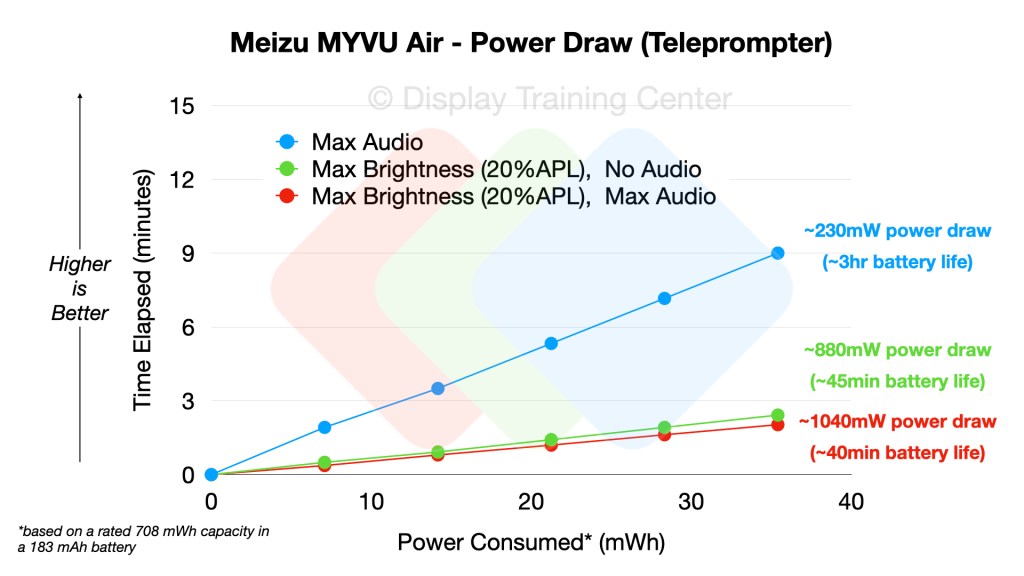
Audio by itself is much more forgiving. At maximum audio output, the system measured around 230 mW, which would imply roughly 3 hours of battery life if you were only using the audio side of the device.
That is the core tradeoff with this product type: the glasses can be lightweight because the battery is small, but once the display is running continuously at high brightness, there just is not that much energy available.
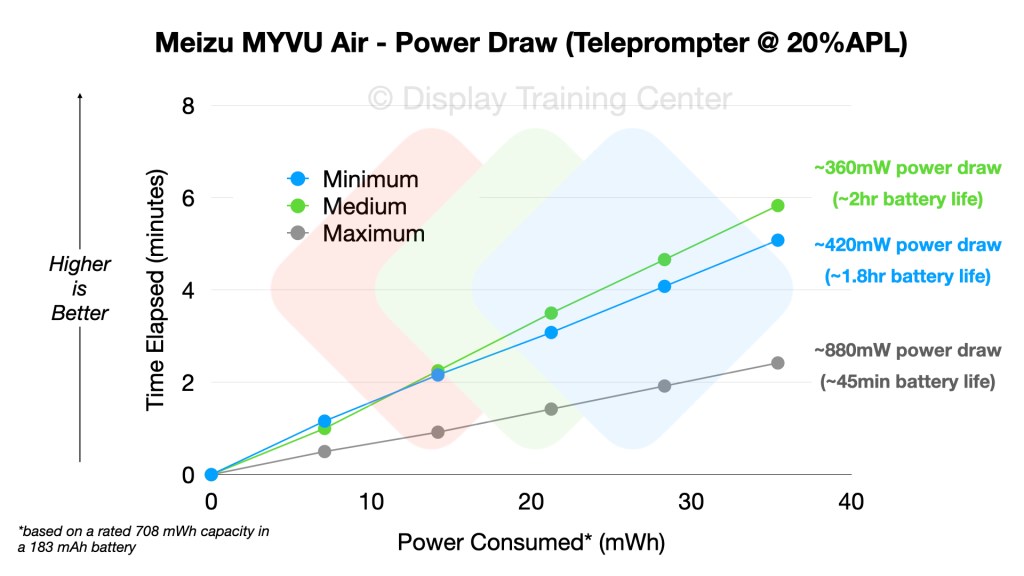
Looking at brightness settings at 20% APL, the high-brightness mode is clearly the expensive one. The maximum setting again lands around 880 mW, while the lower-brightness modes are much closer to the 360–420 mW range, giving something closer to 1.8–2 hours of continuous teleprompter use.
For a sparse notification UI, this is probably fine. For continuous subtitles, teleprompter use, or long translation sessions, the battery life becomes a very real product limitation. This is not necessarily a criticism of Meizu specifically — this is just what happens when you combine a tiny battery, wireless electronics, a display engine, and an always-on use case. I’m also actually quite surprised by the high power draw here… Even Realities is using JBD panels as well (admittedly the newer generation panels, but still… power draw did not improve that much between revisions) and is drawing between 4-5x less for the same brightness settings.
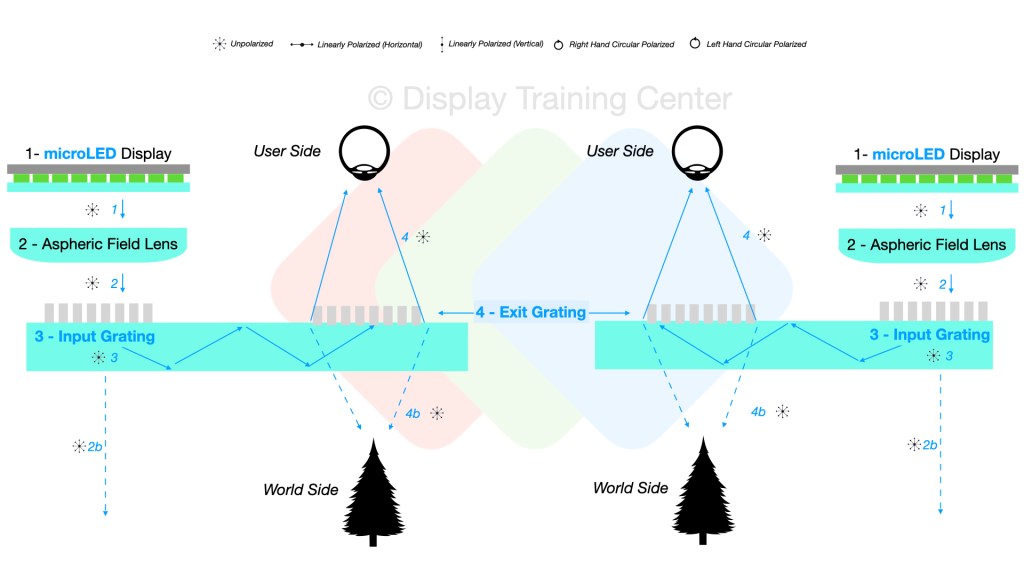
Optically, the MYVU Air uses a pretty familiar monocular-per-eye waveguide architecture. The green microLED display emits into an aspheric field lens, couples into the waveguide through an input grating, propagates through the guide by total internal reflection, and then exits through the output grating toward the user’s eye.
The diagram also shows the uncomfortable truth of waveguides: not all of the light goes where you want it. Some of it continues toward the world side, some of it exits outside the intended eyebox, and some of it is simply lost along the way. This is why these systems need extremely bright source displays even though the final UI looks simple.
That said, for a monochrome green teleprompter-style interface, this is exactly where microLED makes sense. You do not need a full-color image. You do not need cinema-quality contrast. You need a bright, efficient, narrow-band source that can survive a very lossy optical path and still remain readable.
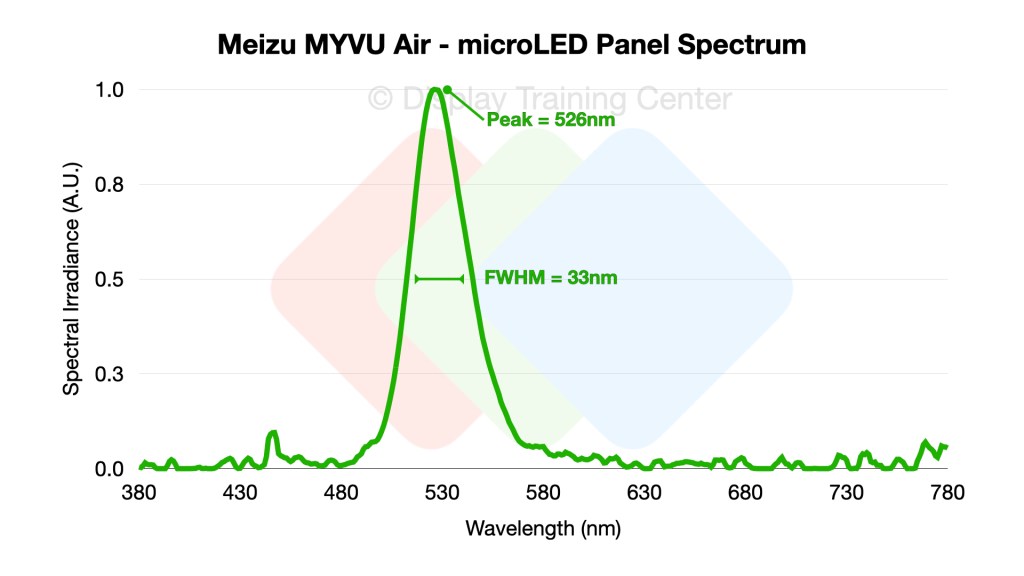
The spectrum is what we would expect from a green inorganic LED emitter: narrow and centered at about 526 nm, with a measured 33 nm FWHM.
This is right in the familiar green microLED range we have seen in other HUD glasses. The exact wavelength matters more than people sometimes assume. It affects perceived color, optical efficiency through the waveguide, user comfort, and the visual character of the UI. In this case, the MYVU Air green looks like the standard “smart-glasses green” — saturated enough to be readable, narrow enough to be efficient, and obviously not trying to pretend it is a full-color display.
Science!
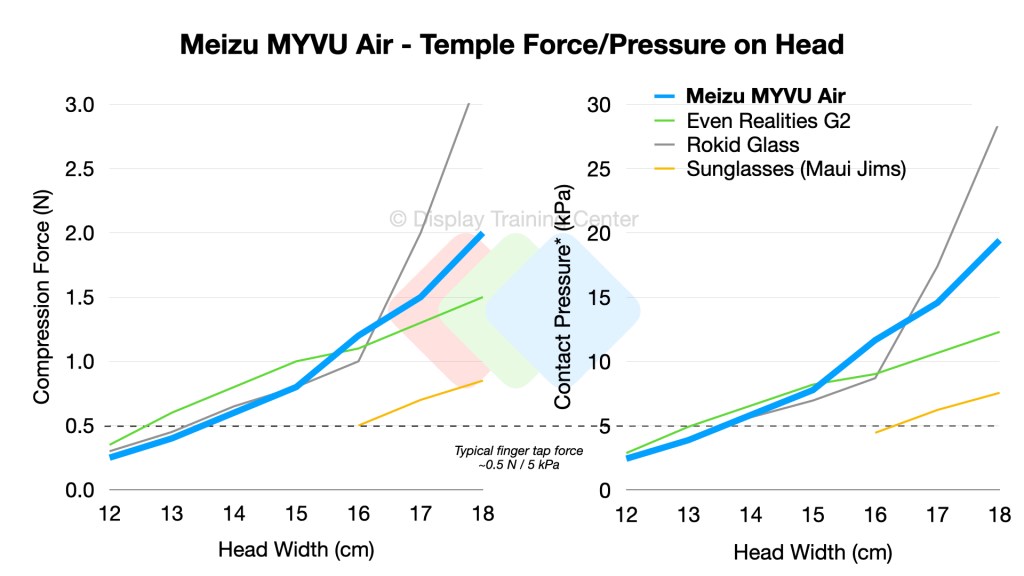
Mechanical comfort is where the MYVU Air does pretty well, but with some caveats. At the advertised 43 g weight, and a measured weight of 43.6 g, Meizu is being honest here. That puts the MYVU Air heavier than the Even Realities G2, measured at 36.6 g, but dramatically lighter than the Meta Ray-Ban Display glasses, measured around 70.3 g.
Across the tested head-width range, the MYVU Air applies more pressure than the Even Realities G2, but less than the Rokid Glasses at the widest fit points. At an 18 cm head width, the MYVU Air reaches roughly 2 N of compression force and just under 20 kPa of contact pressure. That is not sunglasses-level gentle, but it is also not in the “why are these clamping my skull?” category.
This is one of those areas where the product is clearly still a piece of electronics first and eyewear second. The temples need to hold batteries, speakers, electronics, and structural stiffness. The trick is distributing that force over enough contact area that the user does not feel a pressure hotspot after 20 minutes.
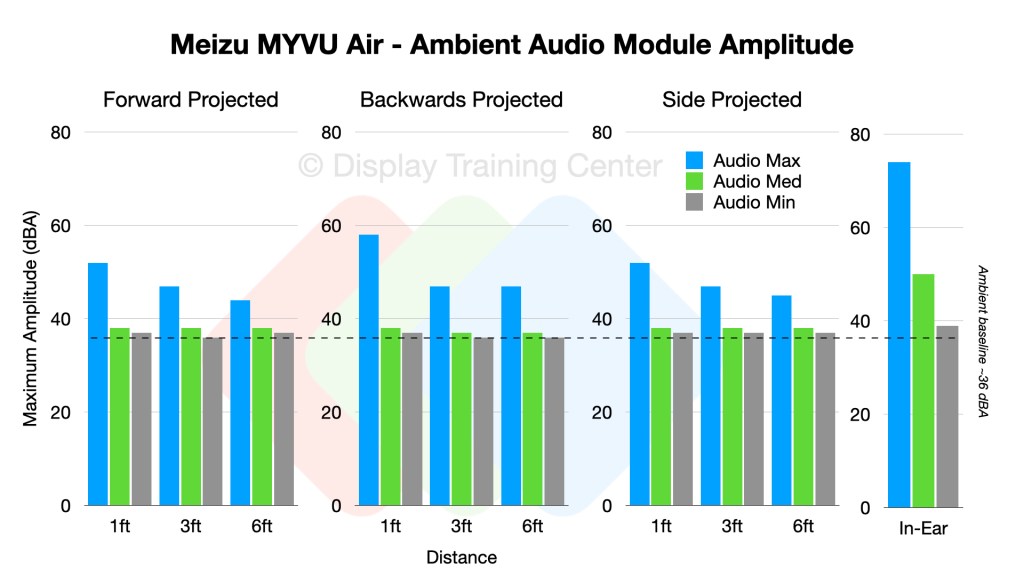
The open-ear audio modules are surprisingly loud when pushed. At maximum volume, the measured amplitude stays well above the ambient baseline across forward-projected, backward-projected, and side-projected measurements. Depending on distance and direction, maximum output lands roughly in the mid-40s to high-50s dBA range, with the in-ear measurement reaching around 74 dBA.
At medium volume, the output is much closer to a practical listening level, while the minimum setting is only slightly above the ambient baseline in most configurations. That is probably where most people will use it unless they are in a noisy environment.
The in-ear result is the important one for actual use: the speakers are capable of delivering enough sound to the wearer without needing sealed earbuds. The obvious downside is that open-ear audio is never truly private, and at higher volumes the people around you are going to hear something.
That is probably the most useful takeaway.
As always, all raw data collected and used here is available for all tiers of paid Patreon subscribers here: www.patreon.com/c/DisplayTrainingCenter

 Display Training Center
Leave a comment